A Feminist Poem at Calvin College – 1936

First some context.
Leaders at Calvin College and leaders and members of the Christian Reformed Church worried about the morality and Christian faithfulness of students at the College. Some feared that it was becoming a hotbed of radicalism. The country was in the midst of the Great Depression, after all, and American voters had moved to the left, twice electing Franklin D. Roosevelt and affirming his “New Deal” policies.
In a student “straw vote” in 1932 a small minority of students at Calvin had expressed support for FDR and a larger one for Norman Thomas, the Socialist candidate. (The Socialist voters may have been having fun, trying to get a reaction from the conservative majority on campus.) Some College and Seminary faculty challenged knee-jerk Christian Reformed opposition to the New Deal in the Calvin Forum. Worse, students refused to stop attending movies and a significant portion affirmed dancing and drinking too.
Much to the frustration of the administration and Board of Trustees, faculty expressed reluctance to police student movie going, saying that it was impossible, since most students lived off campus. Faculty also were divided on the policy itself. Their failure to deal with student movie attendance would lead to something of a crisis at the College in the late 1930s, with the College’s Board of Trustees and a denominational “Committee of Ten” investigating of the quality of the Reformed faith and values of the faculty.
In this context, in February 1936, Chimes published a poem entitled “Feminist.”
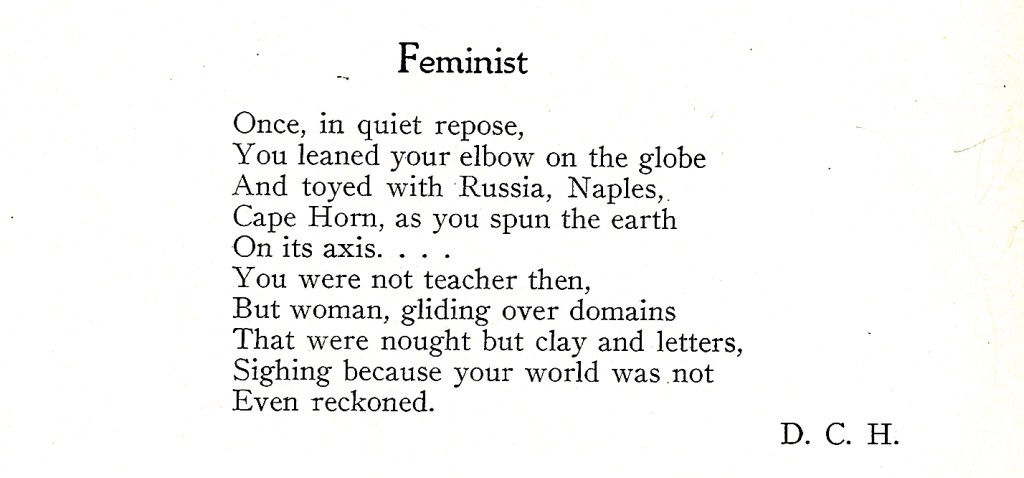
The author was Dorothy Cornelia Hager, the literary editor of Chimes. She was raised on the West Side of Grand Rapids, her father dying when she was only five. She completed the education program at Calvin. Her poem seems to lament that women could only imagine the kinds of opportunities and lives that men could take for granted. The world was open for men in a way it still was not for women, even with women now able to vote and hold public office in the United States, with the passage of the Nineteenth Amendment in 1920.
Earlier in that school year, in December 1935, Hager had published a poem entitled “Eris.”

Another of her poems, which also expressed yearning (a theme in her poems), was about poetry itself.

In an editorial entitled “The Literary Calvinist . . .,” Hager wondered whether a true Calvinist could actually be a literary figure, given the tradition’s theocentrism. She judged that John Milton was the tradition’s only great literary figure. (She either overlooked New England poets such as Anne Bradstreet and Edward Taylor, the latter a Puritan “divine” as well as a poet, or did not consider them great.)
If Hager is an indication, Calvin College administrators and supporters need not have worried about the Christian faith, theology, and vision of its students. They might have been half-right about the radicalism, however. Calvin students were not “radicals” in the sense of being communists or advocates of “free love,” common conservative bugbears in the early twentieth century. But they did push the boundaries of Reformed piety, notably in calling the College to live up to its own stated ideals.
As in the late 1920s, Calvin’s best and brightest in the mid-to-late 1930s demanded that the College fulfill its mission of offering a distinctively Reformed education in which Christian faith spoke to all aspects of learning and life and encouraged social action. Chimes writers like Hager had drunk deeply of this wine and often were impatient with faculty and administrators who in their view reduced the school’s vision of Reformed higher education to doctrinal security and bourgeois propriety.
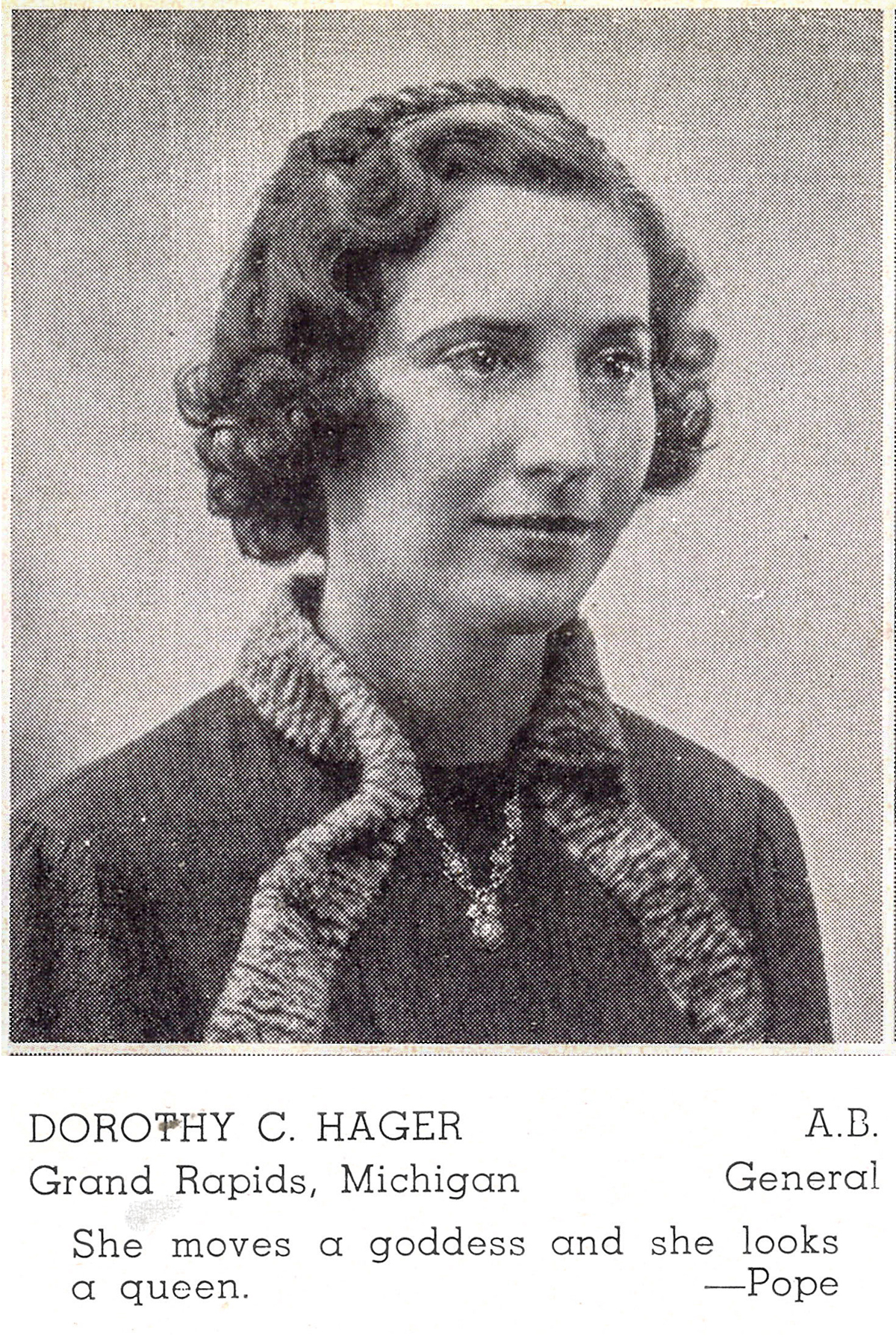
I found only a few traces of Hager after she graduated from Calvin in the spring of 1936, as is common for women graduates from her era. In 1936, she married Albertus “Bert” Groendyk at 7th Reformed Church in West Michigan. Their marriage certificate lists her as a teacher. He was a pastor of a church in Pennsylvania and was seven years older than her. They were living in Huntingdon County in Pennsylvania in 1940, according to the census of that year. It records them as having a daughter, Garland, and a maid, Madeline Davis. In 1942 he was drafted into the army, serving in the Naval Reserves Chaplain Corps during World War II. The 1950 census records Hager and Groendyk living in Baltimore, with three children. He died in 1953 in Cassopolis, Michigan. She passed away in 2005 in Grand Rapids.
***
William Katerberg is a professor of history and curator of Heritage Hall at Calvin University. All images courtesy of Heritage Hall.
Loved your article about my mother, Dorothy Hager Groendyk. It is a lovely homage to a beautiful, brilliant , loving woman who is sorely missed by her family. Thank you very much
Glad you enjoyed it!