Calvin’s First Baccalaureate Degrees

When did Calvin first graduate students with baccalaureate degrees? (And who was the first student to earn one?)
The question might seem straight-forward. Just get the year right. But the past is usually messier than we remember. When we tell the stories of communities and institutions, we often smooth out complications in the interests of narrative clarity.
Let’s start with the straight-forward answer. Calvin became a four-year, baccalaureate degree granting institution in 1920. It graduated its first four-year baccalaureate class in the spring of 1921. And, indeed, in the Prism yearbook for 1921, we see the first Calvin College graduating class with mortar boards and tassels and “A.B.” after their names.
The A.B. graduates are not listed in alphabetical order in Prism or in the commencement program. The first student pictured in Prism is John Kuiper (philosophy, languages). The first student if we go in alphabetical order was Garret Andre (pre-seminary), who went on to serve Christian Reformed churches in the U.S. and Canada. That first class included no women graduating with A.B. degrees. The first women who completed A.B.s graduated in 1922: Margaret Bell and Gertrude Lucas.
Calvin Theological Seminary, then known as the Theological School, awarded diplomas in that era, not Bachelor of Divinity, Master of Divinity, or Bachelor of Theology degrees. Commencement programs first listed Bachelor of Theology graduates in June 1926, the 50th Anniversary year of the Theological School and Calvin College.
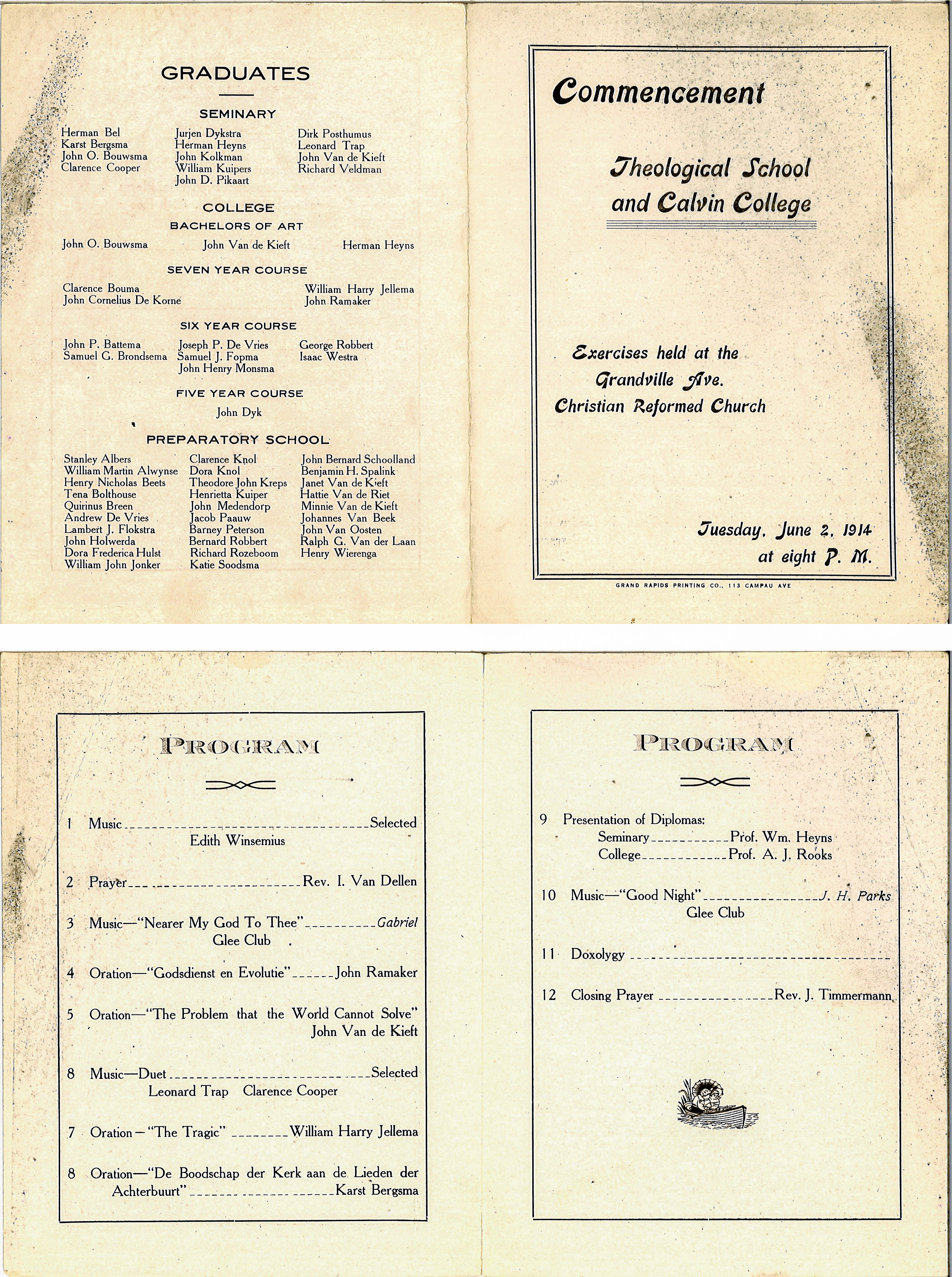
The history of bachelor’s degrees at Calvin College and the Theological School is more complicated than this, however. In 1913 Harm Henry Meeter received the first Bachelor of Arts awarded by Calvin College, according to the Semi-Centennial Volume of 1926. In 1913, the two schools had decided to award B.A. degrees to students who completed the three-year junior college program at Calvin and sufficient course work in the Theological School program.
Meeter went on to Princeton Theological Seminary and then to the Free University in Amsterdam, where he earned a doctorate in theology. He returned to Calvin College in 1926 to teach theology, after serving as a Christian Reformed pastor at Neland Avenue CRC for a decade (1917-1926). He retired in 1956. The H. Henry Meeter Center at Calvin University is named after him. The Meeter Center focuses on John Calvin, Calvinism, the Reformation, and early modern studies. Meeter’s scholarly goal was to make research on Calvin widely available. In 1939 he published The Basic Ideas of Calvinism.
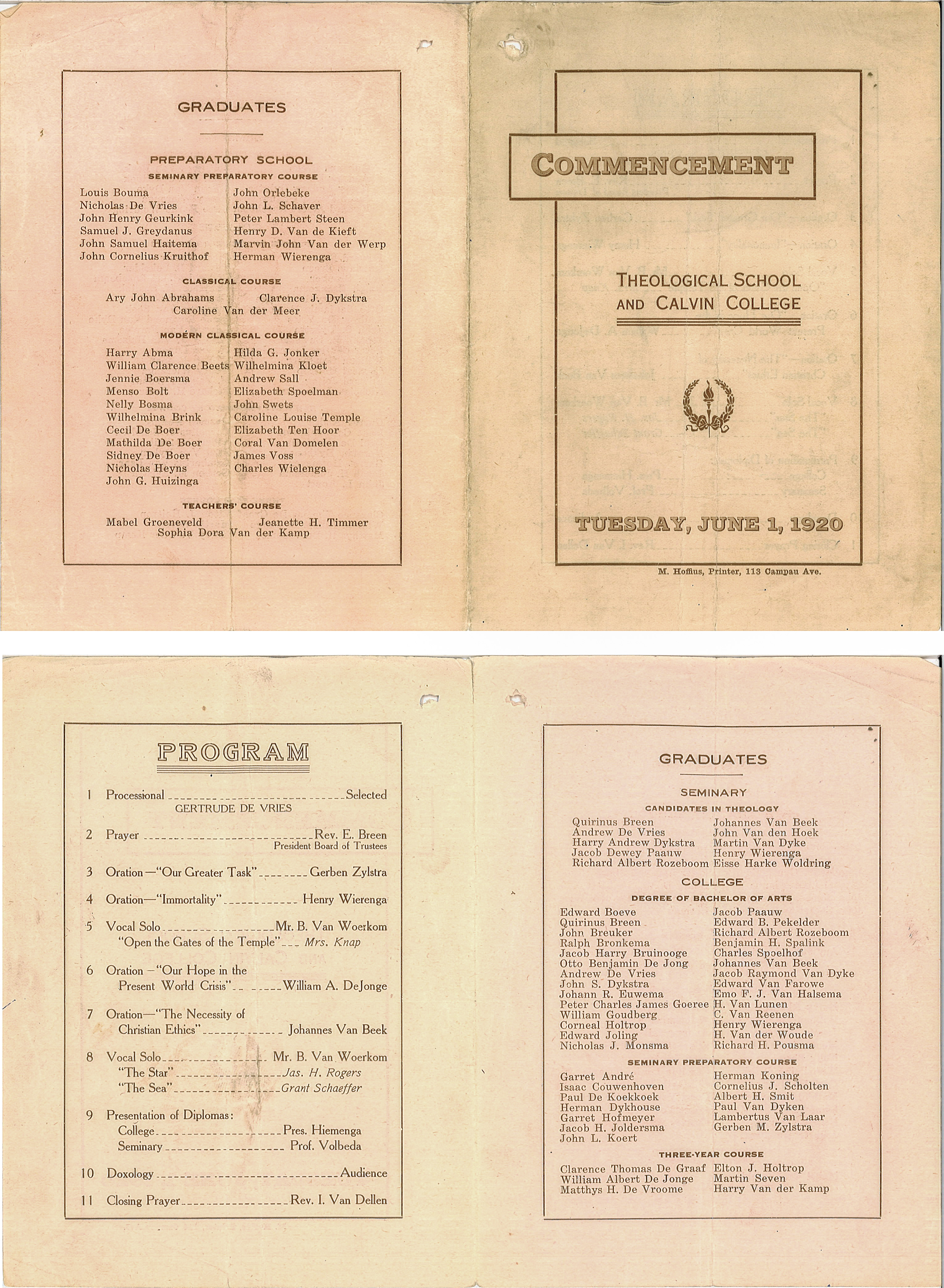
Calvin did not award these ad hoc bachelor’s degree every year between 1913 and 1921, but it did so regularly. In 1914 John O. Bouwsma, John Van de Kieft, and Herman Heyns received B.A.s. (See the image above.) In 1920 more than two dozen graduates did so. (See the image below.) After 1921, Calvin continued to award occasional ad hoc B.A.s to Theological School students, doing so for a time even after the Theological School began to award Bachelor of Theology degrees. Commencement programs also listed occasional ad hoc Bachelor of Arts degrees awarded to three-year Calvin College alumni who had completed sufficient course work in a professional program at another school.
The Commencement program for 1927, for example, lists several students as graduating from three-year programs (but not with B.A.s) in pre-seminary, pre-engineering, pre-law, and pre-medical tracks. It also lists two students as receiving B.A.s after having completed an additional year in a medical school. The 1928 program lists two students receiving B.A.s after a year of medical school and two seminary students who had met the requirements for the “A.B. degree.”
The Commencement programs for 1927 and 1928 also listed over thirty students as having completed the three-year, non-baccalaureate “Normal” program (teacher education). All but one of those students in both years were women. By the 1930s, the vast majority of students intending to become teachers were earning bachelor’s degrees, though a few would still choose the three-year “Normal” program. By the mid-1930s, about 40 percent of students at the College were women, a larger percentage of them intending to become teachers in the CRC’s Christian school system.
How do we explain this ad hoc evolution at Calvin?
The Theological School and some CRC leaders began discussing forming a college in the early 1890s. It took over a decade to organize John Calvin Junior College and enroll students in 1906. In 1910 Calvin College added a third year to the junior college program. It took another decade to add the fourth year, transition from junior college status to baccalaureate college, and begin awarding (regular) baccalaureate degrees.
Repeated failures to raise enough money to add faculty and facilities help explain the long process. So too do conflicts in the 1900s and 1910s over whether the CRC itself should operate a college. Critics argued that it was not properly the job of a church but should be done by a society, as with Christian elementary and high schools. Ironically, the rapid growth of the student body of the junior college and the associated preparatory academy (high school) required raising money to buy land and build a new campus in the 1910s, which probably also delayed the transition. And, even after 1920-1921, the College used the promise of ad hoc B.A.s to attract students interested in professional programs. They could get the best of Calvin’s Reformed approach to learning in their first three years and then finish a professional program at a university with facilities and courses Calvin could not afford to provide.
Creating Calvin College thus was not a smooth process. Amid the complications and delays the College and the Theological School found irregular ways to take steps toward baccalaureate degrees for their students.
***
William Katerberg is a professor of history and curator of Heritage Hall at Calvin University.
The cover image of the blogpost is a sketch of the Franklin campus featuring the administrative building. The land for the campus was purchased in 1909. The move to the new campus was in 1917. This is likely is an architect’s sketch from the early to mid-1910s to help envision what the planned campus would look like. Courtesy of the Heritage Hall Archives.