Modern Calvinism, the Plato Club, and the Calvin ‘Colony’ at Michigan

Calvin College’s relationship with the University of Michigan began in the 1890s. In its founding in 1876 the Theological School (as the seminary was known then) had created a “literary” program to prepare students with no high school education for its theological program. In the late 1890s the literary program evolved into a preparatory academy for a broader range of students (e.g., future Christian school teachers), the first non-seminary-bound students starting in 1900. The expanded program opened to women students in 1901.
Like many high schools in Michigan, the preparatory academy structured its curriculum so that graduates could enter the University of Michigan without having to take an entrance exam. The curriculum of John Calvin Junior College, with its first class beginning in 1908, similarly made it easy for alumni to transition to Michigan. Soon renamed Calvin College, the school became a four-year baccalaureate institution in 1920.

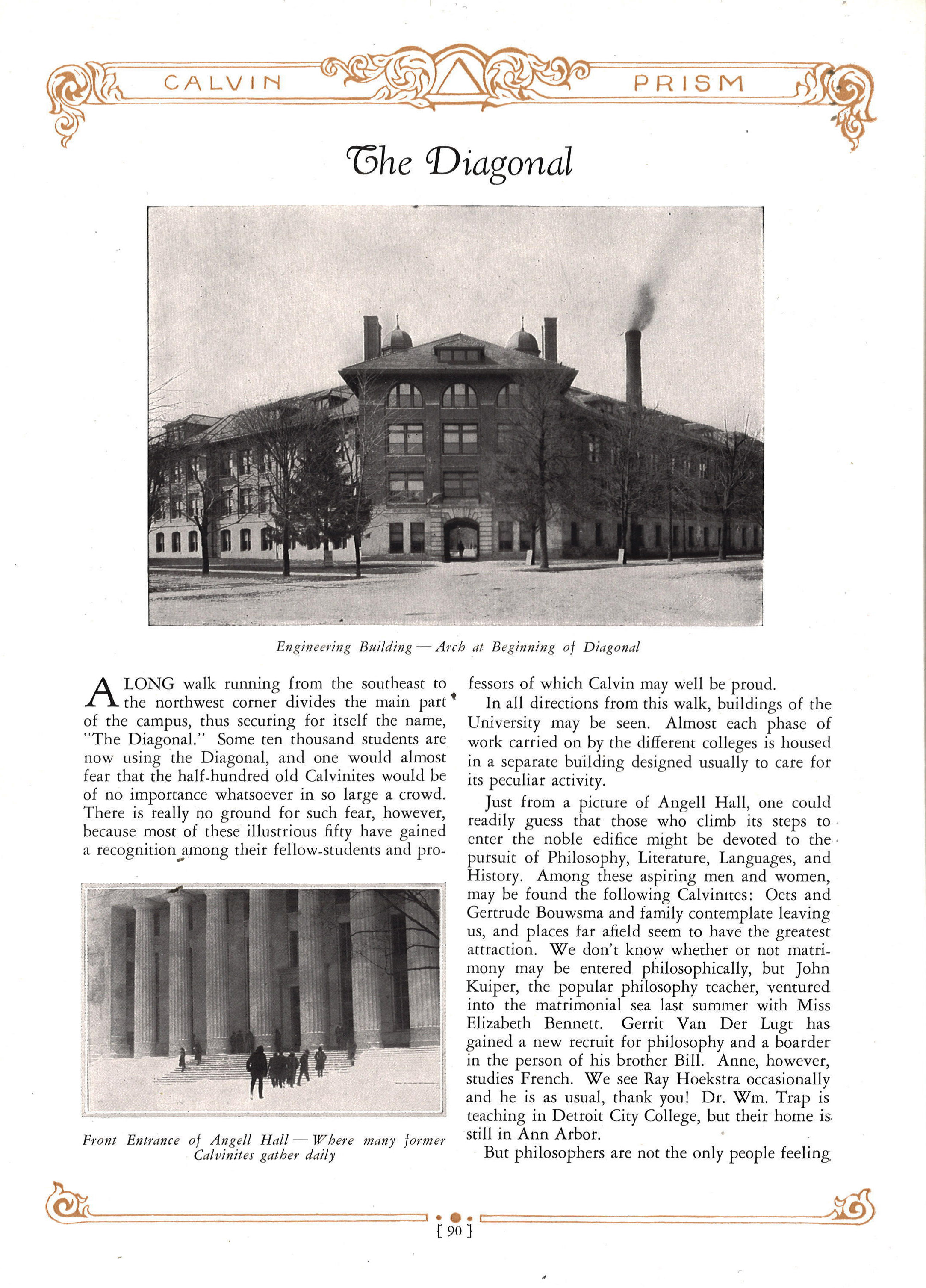
By the mid-1920s there were dozens of Calvin alumni at Michigan, studying everything from philosophy and sociology to history, biology and dentistry, enough of them to form a Calvin “colony” of sorts in Ann Arbor. (Calvin alumni also went to other Michigan and Midwestern universities to continue their education.) Many in the colony retained strong ties to the College, even among those who had rebelled against what they viewed as intellectual, cultural, and religious constraints at Calvin.
The ties between the colony and Calvin College were strong enough that the Prism yearbooks of 1927 and 1928 included reports from alumni at Michigan. In the1929 Prism the report was more broadly about what recent alumni were up to, with reports from Ann Arbor, Chicago, and beyond.
In April 1926 one of those recent alumni (1925) at Michigan, Ben Euwema, returned to Calvin to give a paper at a meeting of the Plato Club. The club was led by philosophy professor Harry Jellema, a Calvin alum (1914) and a graduate of Michigan’s PhD program (1922) who had started teaching at Calvin in 1920. Euwema had been the club’s president in 1924-1925. His paper is in Heritage Hall’s collection of Jellema’s papers.
The club’s purpose, in Euwema’s said, was to reconcile the Reformed tradition with modern thought. Its members tended to be “progressive” by Calvin standards, seeking engagement with modern thought, rather than “conservative” or “traditional” in the sense of tending to see modern ideas as incompatible with Calvinism. Euewema addressed club members as “Fellow Idealists,” referring to a modern philosophical tradition. Jellema was known to be sympathetic to Idealism, and he generally believed that Christians could potentially learn useful things from both ancient philosophers (hence “Plato” Club) and modern ones, reflecting the theology of common grace (see below on this theology).
Some Plato Club members were conservative or would become conservative in later years and were more skeptical about the idea that Christians could learn from non-Christians. The club for seminary and college students that tended to be conservative was Nil Nisi Verum (Latin for “nothing but the truth”), which was led by Samuel Volbeda, a seminary professor.
In his paper, Euwema said that he and his fellow travelers in Ann Arbor preferred “to claim a relationship with Calvin much more eagerly than with Michigan.” He emphasized that philosophically minded students at Calvin and Michigan had “the same situation to face, the same problems to confront.” That is, pursuing “the final correlation of our inherited theology and the greatest philosophical answers to the enigmas of life.” These “enigmas” were issues such as evolution vs. creation; higher criticism of the Hebrew and Christian scriptures; and new currents in theology and philosophy. Such issues were not unique to Reformed Christians but familiar to Protestants generally and to Roman Catholics and Jews.

Euwema praised “the healthy intellectual attitude” of the Christian Reformed Church—its commitment to serious theology and Christian tradition—comparing it to the “spineless flabbiness” and “cynicism” of many “modernist” thinkers and artists. The flaws he saw in Calvinism, he said, were not fundamental to the tradition but merely out-of-date understandings of some aspects of it. Calvinism, especially in articulating a full worldview, needed to be re-interpreted “in the light of modern scholarship.” Likewise, “the individual personality or mind” needed “liberation” from the “trammels of an autocratic and tradition-bound regime.” This last point likely was directed at the College’s and the Christian Reformed Church’s leadership.
“We want,” Euwema said, “a life which will be able to include the aesthetic as well as the moral, the secular as well as the clerical.” This “we” presumably referred to both members of the colony in Ann Arbor and the Plato Club at Calvin. “Our” goal is “making our inherited Calvinistic system a vital force in our lives.”
It was a heady vision of pursuing a modern Calvinism, one likely to inspire opposition from some traditional Calvinists, whether at Calvin and in the CRC or at fundamentalist Presbyterian redouts like Westminster Theological Seminary and the Orthodox Presbyterian Church. Westminster would be founded in 1929 (with several faculty leaving the more moderate to liberal Princeton) and the OPC in 1936. Westminster faculty would include Calvin graduates such as R. B. Kuiper, Cornelius Van Til, and Ned Stonehouse. Kuiper also would serve as president of Calvin College (1930-1933) and the Seminary (1952-1956).
Suspicion of Jellema’s philosophical Idealism and fear that he might be leading students astray would lead to an investigation of him by seminary and college faculty from 1926 to 1928. In 1935 a combatively orthodox Calvin College president, Ralph Stob, pushed Jellema hard enough that he left for the philosophy department at Indiana University. Stob, who alienated other faculty on other issues, and many students too, would not be reappointed in 1939 because of faculty opposition.
The Christian Reformed Church (CRC) and so Calvin College and the Theological School had in 1924 affirmed “common grace”—the idea that God “favors” all people and all creation with a kind of grace, restraining sin so that even people without true faith live with some virtue and true knowledge. This theology in theory meant that Christians could learn from non-Christian thinkers and artists. But, in practice, the CRC and Calvin were suspicious of actually doing so. For example, in addition to pushing out Jellema, they fired two seminary professors, Ralph Janssen (for discussing and using element of biblical criticism in his classes) and B. K. Kuiper (for going to movies).
The difficult position Jellema found himself in at Calvin in the late 1920s and the1930s was mirrored by the religious choices of Calvin alumni who became scholars, including those in the colony at the University of Michigan. Some of those alumni kept ties with the CRC; others migrated to more moderate or progressive denominations; and still others left Christianity behind entirely. In common, all of them had careers with greater freedom to explore ideas and topics than they would have had at Calvin during the 1920s and 1930s.
The philosophers among these alumni included Cornelius De Boe (mainline Protestant), Jesse De Boer (CRC), John Kuiper (mainline Protestant), O. K. Bouwsma (CRC), Gerrit Schipper (mainline Protestant), William Frankena (mainline Protestant), Don Stuurman (atheist), and Tunis Prins (CRC). Euwema himself, who went on from Michigan to earn a PhD at Chicago and teach literature at Michigan State, became a mainline Protestant.
Tunis Prins and Jellema himself would return to Calvin—Jellema in 1947 and Prins in 1961. The Calvin College they returned to would be different—still rigorously Reformed, but more open to engaging the wider intellectual and cultural world positively (as well as critically), putting the idea of common grace into practice.
Jellema would shape a generation of students at Calvin that included future stars in the philosophy department such as Nicholas Wolterstorff and Alvin Plantinga. After retiring from Calvin in the early 1960s, Jellema would go on to build the philosophy department at the new Grand Valley State College in Allendale, Michigan (since 1987, Grand Valley State University).
***
William Katerberg is a professor of history and curator of Heritage Hall at Calvin University.
The cover photo of the blogpost is a crop of the members of the Plato Club in the 1925 edition Prism yearbook of Calvin College. This blogpost uses unpublished research on the history of Calvin University by Michael Hamilton.