The little “trade school” for pastors founded by the Christian Reformed Church (CRC) in 1876 has evolved into Calvin Theological Seminary and Calvin University. Every twenty-five years, starting with its fiftieth anniversary in 1926, Calvin has retold its story. In 1901, the Theological School and …
Most people who know that Calvin Theological Seminary and Calvin University have had more than one campus only know about the “Franklin” campus on what is now Martin Luther King Jr. Street. A few know about the “Madison” campus, at the corner of Madison and …
Calvin College’s relationship with the University of Michigan began in the 1890s. In its founding in 1876 the Theological School (as the seminary was known then) had created a “literary” program to prepare students with no high school education for its theological program. In the late 1890s the literary program evolved into a preparatory academy for a broader range of students (e.g., future Christian school teachers), the first non-seminary-bound students starting in 1900. The expanded program opened to women students in 1901.
Like many high schools in Michigan, the preparatory academy structured its curriculum so that graduates could enter the University of Michigan without having to take an entrance exam. The curriculum of John Calvin Junior College, with its first class beginning in 1908, similarly made it easy for alumni to transition to Michigan. Soon renamed Calvin College, the school became a four-year baccalaureate institution in 1920.
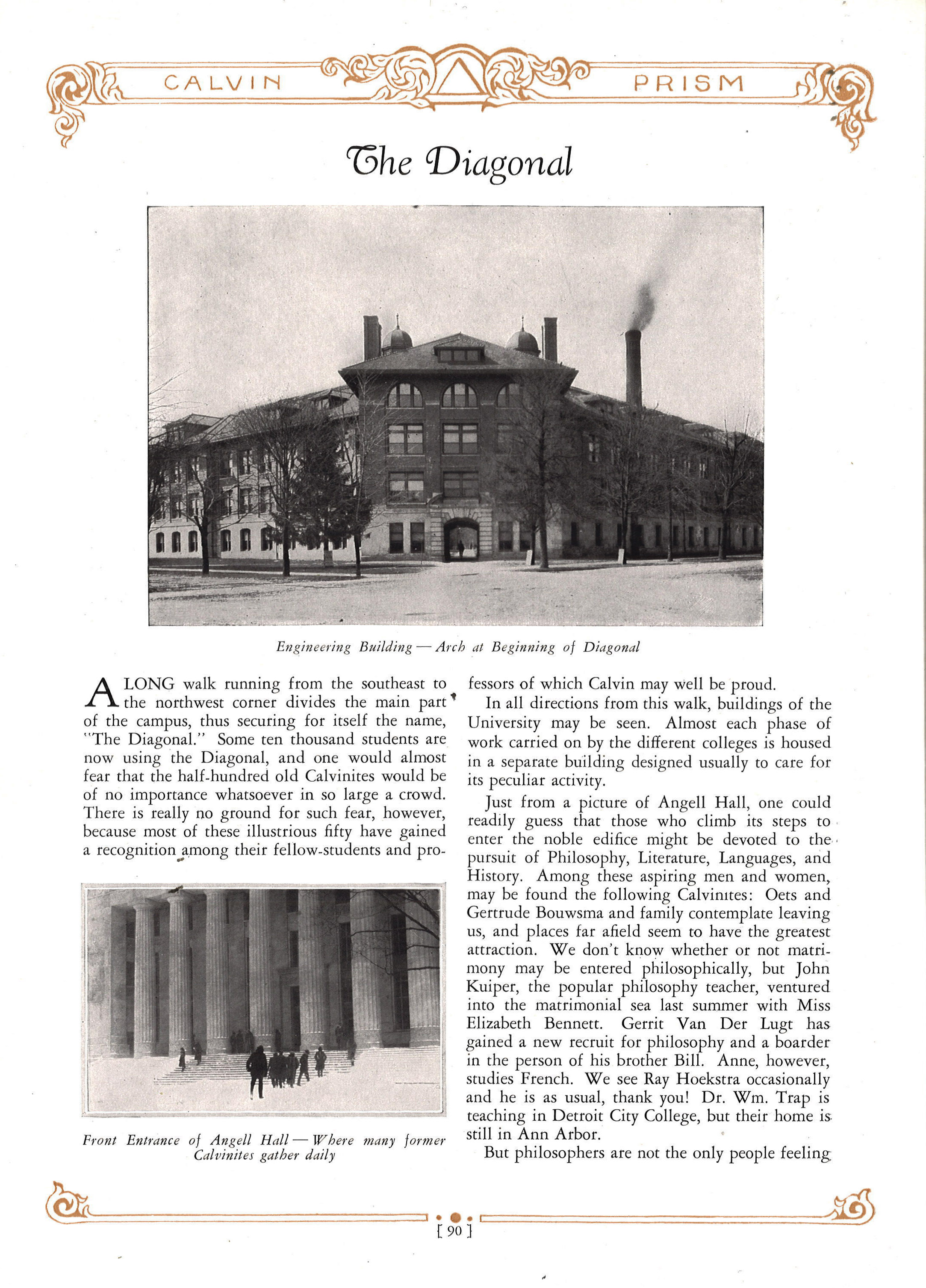
Report on the Michigan “colony” in the 1927 Prism. Click on the image for a PDF.
By the mid-1920s there were dozens of Calvin alumni at Michigan, studying everything from philosophy and sociology to history, biology and dentistry, enough of them to form a Calvin “colony” of sorts in Ann Arbor. (Calvin alumni also went to other Michigan and Midwestern universities to continue their education.) Many in the colony retained strong ties to the College, even among those who had rebelled against what they viewed as intellectual, cultural, and religious constraints at Calvin.
The ties between the colony and Calvin College were strong enough that the Prism yearbooks of 1927 and 1928 included reports from alumni at Michigan. In the1929 Prism the report was more broadly about what recent alumni were up to, with reports from Ann Arbor, Chicago, and beyond.
In April 1926 one of those recent alumni (1925) at Michigan, Ben Euwema, returned to Calvin to give a paper at a meeting of the Plato Club. The club was led by philosophy professor Harry Jellema, a Calvin alum (1914) and a graduate of Michigan’s PhD program (1922) who had started teaching at Calvin in 1920. Euwema had been the club’s president in 1924-1925. His paper is in Heritage Hall’s collection of Jellema’s papers.
The club’s purpose, in Euwema’s said, was to reconcile the Reformed tradition with modern thought. Its members tended to be “progressive” by Calvin standards, seeking engagement with modern thought, rather than “conservative” or “traditional” in the sense of tending to see modern ideas as incompatible with Calvinism. Euewema addressed club members as “Fellow Idealists,” referring to a modern philosophical tradition. Jellema was known to be sympathetic to Idealism, and he generally believed that Christians could potentially learn useful things from both ancient philosophers (hence “Plato” Club) and modern ones, reflecting the theology of common grace (see below on this theology).
Some Plato Club members were conservative or would become conservative in later years and were more skeptical about the idea that Christians could learn from non-Christians. The club for seminary and college students that tended to be conservative was Nil Nisi Verum (Latin for “nothing but the truth”), which was led by Samuel Volbeda, a seminary professor.
In his paper, Euwema said that he and his fellow travelers in Ann Arbor preferred “to claim a relationship with Calvin much more eagerly than with Michigan.” He emphasized that philosophically minded students at Calvin and Michigan had “the same situation to face, the same problems to confront.” That is, pursuing “the final correlation of our inherited theology and the greatest philosophical answers to the enigmas of life.” These “enigmas” were issues such as evolution vs. creation; higher criticism of the Hebrew and Christian scriptures; and new currents in theology and philosophy. Such issues were not unique to Reformed Christians but familiar to Protestants generally and to Roman Catholics and Jews.
The Plato Club in the 1925 Prism. It lists Euwema as its president. Click on it for a larger view.
Euwema praised “the healthy intellectual attitude” of the Christian Reformed Church—its commitment to serious theology and Christian tradition—comparing it to the “spineless flabbiness” and “cynicism” of many “modernist” thinkers and artists. The flaws he saw in Calvinism, he said, were not fundamental to the tradition but merely out-of-date understandings of some aspects of it. Calvinism, especially in articulating a full worldview, needed to be re-interpreted “in the light of modern scholarship.” Likewise, “the individual personality or mind” needed “liberation” from the “trammels of an autocratic and tradition-bound regime.” This last point likely was directed at the College’s and the Christian Reformed Church’s leadership.
“We want,” Euwema said, “a life which will be able to include the aesthetic as well as the moral, the secular as well as the clerical.” This “we” presumably referred to both members of the colony in Ann Arbor and the Plato Club at Calvin. “Our” goal is “making our inherited Calvinistic system a vital force in our lives.”
It was a heady vision of pursuing a modern Calvinism, one likely to inspire opposition from some traditional Calvinists, whether at Calvin and in the CRC or at fundamentalist Presbyterian redouts like Westminster Theological Seminary and the Orthodox Presbyterian Church. Westminster would be founded in 1929 (with several faculty leaving the more moderate to liberal Princeton) and the OPC in 1936. Westminster faculty would include Calvin graduates such as R. B. Kuiper, Cornelius Van Til, and Ned Stonehouse. Kuiper also would serve as president of Calvin College (1930-1933) and the Seminary (1952-1956).
Suspicion of Jellema’s philosophical Idealism and fear that he might be leading students astray would lead to an investigation of him by seminary and college faculty from 1926 to 1928. In 1935 a combatively orthodox Calvin College president, Ralph Stob, pushed Jellema hard enough that he left for the philosophy department at Indiana University. Stob, who alienated other faculty on other issues, and many students too, would not be reappointed in 1939 because of faculty opposition.
Report on the colony at Michigan in the 1928 Calvin College Prism yearbook. Click on the image for a larger view.
The difficult position Jellema found himself in at Calvin in the late 1920s and the1930s was mirrored by the religious choices of Calvin alumni who became scholars, including those in the colony at the University of Michigan. Some of those alumni kept ties with the CRC; others migrated to more moderate or progressive denominations; and still others left Christianity behind entirely. In common, all of them had careers with greater freedom to explore ideas and topics than they would have had at Calvin during the 1920s and 1930s.
The philosophers among these alumni included Cornelius De Boe (mainline Protestant), Jesse De Boer (CRC), John Kuiper (mainline Protestant), O. K. Bouwsma (CRC), Gerrit Schipper (mainline Protestant), William Frankena (mainline Protestant), Don Stuurman (atheist), and Tunis Prins (CRC). Euwema himself, who went on from Michigan to earn a PhD at Chicago and teach literature at Michigan State, became a mainline Protestant.
Tunis Prins and Jellema himself would return to Calvin—Jellema in 1947 and Prins in 1961. The Calvin College they returned to would be different—still rigorously Reformed, but more open to engaging the wider intellectual and cultural world positively (as well as critically), putting the idea of common grace into practice.
Jellema would shape a generation of students at Calvin that included future stars in the philosophy department such as Nicholas Wolterstorff and Alvin Plantinga. After retiring from Calvin in the early 1960s, Jellema would go on to build the philosophy department at the new Grand Valley State College in Allendale, Michigan (since 1987, Grand Valley State University).
***
William Katerberg is a professor of history and curator of Heritage Hall at Calvin University.
The cover photo of the blogpost is a crop of the members of the Plato Club in the 1925 edition Prism yearbook of Calvin College. This blogpost uses unpublished research on the history of Calvin University by Michael Hamilton.
Part I of this story began by describing the founding of the Calvin Seminary Dames club in 1927, when a few of the wives of seminary students began meeting to socialize and discuss “such topics as might later prove helpful in our station as wives, …
“In the month of October 1927, Mrs. C. Bouma entertained the ladies of the married men of the Calvin Seminary.” So reads the first sentence “in the “Record Book of Calvin Seminary Dames” (aka, the club’s minutes book). “At this gathering they spoke somewhat carelessly …
This blog post summarizes, excerpts, and links to a story done by Chimes, the student newspaper at Calvin University. The Chimes story is based on a summer research project done by student researchers Gabby Freshly and Natalie Sytsma and supervised by art history professor Craig Hanson. The project was funded by Calvin’s McGregor program: “Calvin’s Knollcrest Campus: A Fifty-Year Celebration, 1973-2023.”
[There’s a link to the story below, after some Fyfe drawings, photos of the campus, a summary of the Chimes story, and an excerpt from it.]
The Knollcrest campus of Calvin University and Calvin Theological Seminary are a product of a philosophy of Christian education and the aesthetic vision of William Fyfe and his famous mentor Frank Lloyd Wright. College president William Spoelhof gave Fyfe homework–essays and books by Calvin faculty describing the school’s approach to higher education. Fyfe eventually believed that the Knollcrest campus was the finest work he had done in his career. The project restored his faith in higher education.
The cover image for this post is a conceptual drawing down by Fyfe’s team in 1959, as they were working out this philosophy, aesthetic, and vision and imagining the shape and look of the projected campus.
The context was Calvin College and Seminary outgrowing the old “Franklin” campus, as student numbers rose from several hundred students in the mid-1940s to about 3000 by 1960. The whole of higher education in North America was booming in the two decades after World War II, in a “golden age” for higher education. Calvin purchased the Knollcrest farm in the 1950s and the college and seminary built the campus and moved into it gradually during the 1960s and early 1970s. Calvin went from being a school in the city to one in suburbs.
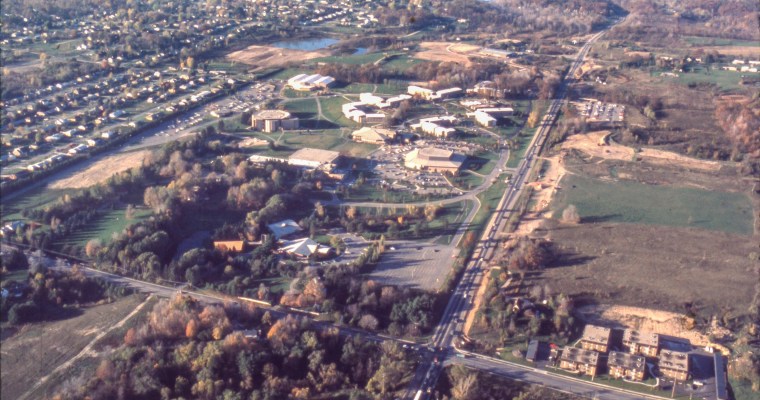
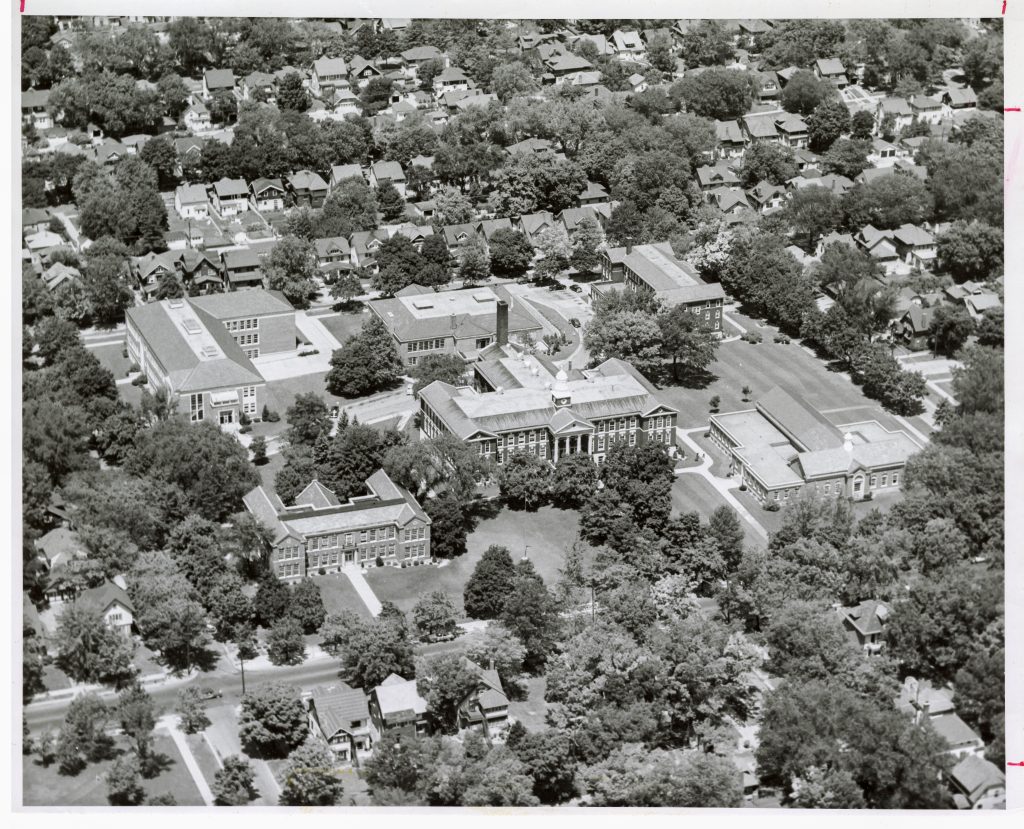
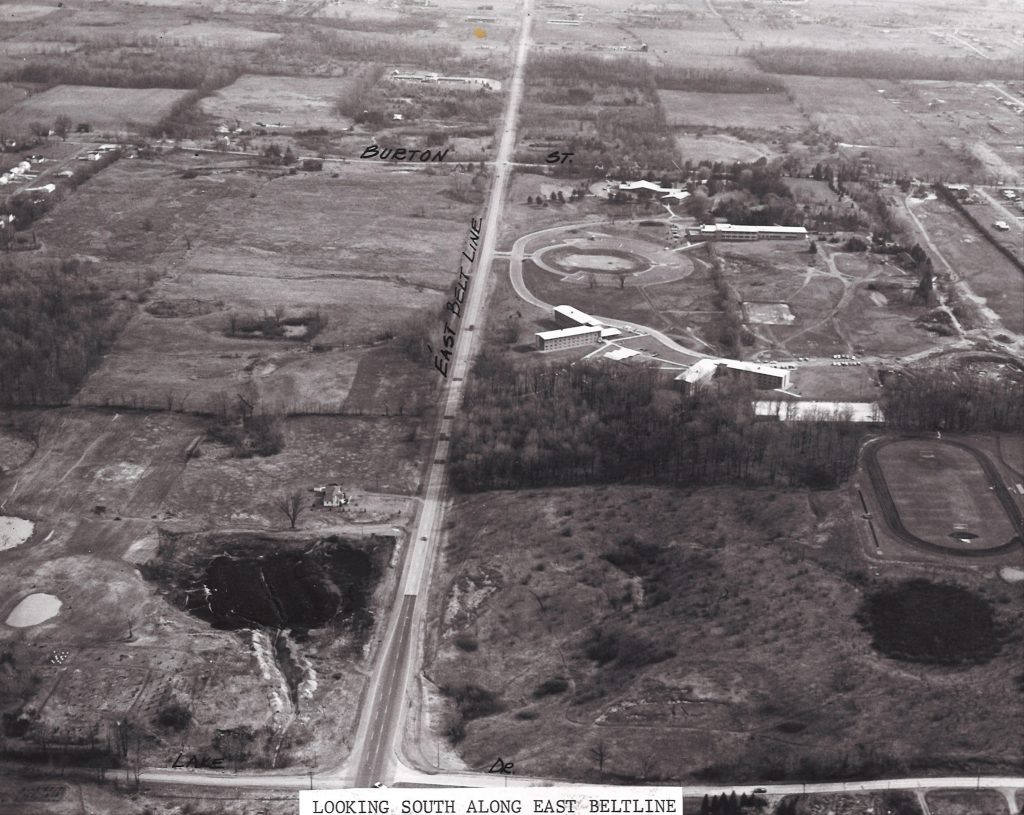
The Calvin campus on Franklin Street in the 1960s. Image courtesy of Heritage Hall.The Knollcrest farm at time of purchase, looking north from Burton Street. Image courtesy of Heritage Hall.Early development of the campus, looking south from Lake Street towards Burton, with a track, a few dorms, a classroom building (Hiemenga Hall), and the seminary (at Burton Street. Image Courtesy of Heritage Hall.
Here’s an early part of the Chimes story:
In 1956, Calvin College — under the leadership of President William Spoelhof — purchased Knollcrest farm. Calvin’s campus at the time was located on Franklin Street, in the heart of Grand Rapids. But after World War II, the college had experienced a period of intense growth — so much growth that the Franklin campus began to feel claustrophobic.
“Spoelhof was projecting in the future that Calvin’s intense growth would continue,” said art history professor Craig Hanson, who conducted research on Calvin’s architecture this past summer. Knollcrest farm — the site of Calvin’s current campus — offered ample opportunity for expansion.
Spoelhof turned to architecture firm Perkins and Will, which Hanson described as “the most progressive architects for education,” to design and build the new campus.
“Spoelhof goes to [Perkins and Will] with the intention to produce a modern campus,” said Hanson. “I take Spoelhof’s aim, above all, to be cultural engagement — an assertion that, whatever is going to happen on this campus, it will matter in the present, not in the past. And, implicitly, it will matter in the future.”
The firm assigned architect William Fyfe, a student of Frank Lloyd Wright, to the project.
Fyfe was a proponent of Prairie style architecture — a style focused on the integration of buildings and landscape via elements like flat roofs and natural colors. “The buildings aren’t supposed to dominate,” said Gabrielle Freshly, one of Hanson’s student researchers. Instead, “they’re supposed to look like they’re springing up.”
The Chimes article goes on to take the story of the Calvin campus into the present. It describes the social and cultural context of the “master plan” for the college (now university) and seminary campus, in a time of transition for the two institutions and the Christian Reformed Church, all serving a long-time immigrant denomination that had recently Americanized and become more middle class and prosperous (along with many other post-war Americans).
Overhead sketch of the seminary facility, ca. 1960. Image courtesy of Heritage Hall.Overhead view of proposed library, classroom, and administrative building, loosely similar to Hekman Library, Hiemenga Hall, and the Spoelhof Center as built (ca. 1960). Image courtesy of Heritage Hall.
The Chimes authors take the story into the present, examining how the campus has evolved in the 50 years since it was first built–as its curriculum grew (e.g., adding a variety of professional and graduate programs) and its student body, staff, and faculty became more religiously, ethnically, and racially diverse.
How do the philosophy, aesthetic, and values in the original master plan look today? What tensions and challenges mark the campus today? What of Fyfe’s vision endured? What has changed?
Dr. Wiebe Boer is the __________ president of Calvin University. a) Second b) Tenth c) Eleventh d) Twelfth The answer to the multiple-choice question is trickier than you might think. Anyone who tells you that facts are facts is half wrong. The answer depends less …
Calvin “University” is about five months old. The idea of a “Calvin University” goes back almost a century, to the founding era of Calvin College as a four-year, bachelor’s degree-granting school. In 1926 to mark Calvin’s fiftieth anniversary, supporters published the Semi-Centennial Volume: Theological School …
Garrett Heyns (1891-1969)
died five decades before the Calvin Prison Initiative was born, but it is a part of his legacy. Heyns was a
Christian educator whose vocation took an unexpected turn in 1937.
Things started conventionally enough for the Calvin alum. He was born into the Christian Reformed Church. His father William W. Heyns, a Dutch immigrant, became professor of practical theology at the Calvin seminary when Garrett was in his teens. Young Garrett attended Calvin Junior College, graduating in 1911. He earned his AB (1915), MA (1916), and PhD (1927) from the University of Michigan.
As might be expected,
Heyns chose to serve his community. He taught in Christian schools in Michigan
and New Jersey. And he served as an administrator in Christian schools in
Michigan, Illinois, and Iowa, including as superintendent of the Christian
Schools in Holland, Michigan for nine years.
The turn in his career
came in 1937, when he became the warden of the Michigan Reformatory in Ionia.
Heyns’ second career was in prisons. But he remained an educator and took his
Christian vision and values with him in this new work.
Michigan Reformatory, 1920s
Michigan appointed Heyns
State Director of Corrections in 1940. In 1949 he returned to the Reformatory.
In 1957 he became director of the State of Washington Department of Institutions.
In both states Heyns promoted education and reform for prisoners. In 1966, on
his retirement, he accepted an offer from the federal government to become executive
director of the Joint Commission on Correctional Training.
Heyn’s vocation took him
across the country and from jobs in Christian schools to work in reform schools
and prisons. But he remained a faithful son of the church. Characteristically,
he helped to organize a Christian Reformed congregation in Tacoma, Washington.
Heyns’s faith greatly also
influenced his views on crime and rehabilitation. He believed that law is “the
expression of the will of God” and “based upon eternal principles of right and
justice as revealed in scripture.” Violations of the law thus were not only crimes
against society, but sins against God. Heyns believed that the maintenance of
law and order was of importance to Reformed Christians because of their
interest in the safety of their fellow human beings. These beliefs motivated him
to focus on the reform of offenders because his ultimate concern was their
eternal welfare.
In Heyns’s eyes, the
path towards reform was a useful and meaningful education. In a 1954 planning
document for a new correctional institution, he wrote, “Courses should be
practical. The emphasis should be on those courses that will broaden horizons,
provide concepts with which to make better social adjustment, and usable in a
field of endeavor which will make the greatest appeal to the individual.” Heyns
practiced what he preached, proposing business and high school courses as well
as on-the-job training for maintenance and industrial jobs.
The Garrett Heyns collection in Heritage Hall contains syllabi used for his courses. Heyns’ approach to education was holistic and included plans for health social environments, physical education, and recreation. It was not enough to train minds in the classroom. Education and reform required healthy bodies and spirits.
The Heyns collection also
contains materials from courses he taught on penology and administration for
employees in prisons. An exam from one of these classes asks students to
reflect on probation, parole, prison education and discipline. Materials for a
course on prison management move connect philosophy to the physical features of
prisons, budgets, administrative organization, and prison industries.
As with education for
inmates, Heyn’s vision for prisons was holistic. “This business of arousing interest of stimulating motivation for the
education program is not the job of any one man,” he explained. “There must be
a combination of forces. To arouse interest one must have an enthusiastic
warden, an interested staff, inspired educators, a fully equipped,
well-integrated program.”
Henys received Calvin’s first distinguished alumni award in 1966, and a dorm on campus is named after him. His vision lives on today at Calvin—and where he started in 1937, in Ionia. In 2011, Garrett Heyns’ grandson and former Michigan Department of Corrections Director, Dan Heyns, helped create the Calvin Prison Initiative, a partnership between Calvin University and the Michigan Department of Corrections to form a unique prison education program that changes prisoners’ hearts by enriching their minds.
Housed at Handlon Correctional Facility in Ionia, the program offers a bachelors degree in faith and community leadership and a minor in social work. It is located near the reformatory site Garrett work at during the 1930s-1950s.
Garrett Heyns graduated from Calvin when it did not yet offer bachelors degrees. Today, Calvin offers associates and bachelors degrees at its Handlon campus. The first students will graduate with bachelors degrees in May 2020. A century after Heyn’s graduation from Calvin, the Calvin Prison Initiative is carrying on his work.
Emily Koelzer is an
archives metadata assistant in Heritage Hall at Calvin University.
Origins Online? Why? I am a digital person. I have a blog and several social media accounts. But I remember when life was analog. I learned to type on a manual typewriter in the early 1980s. In college I wrote papers and an undergraduate thesis …