The Campuses of Calvin College and Seminary
Most people who know that Calvin Theological Seminary and Calvin University have had more than one campus only know about the “Franklin” campus on what is now Martin Luther King Jr. Street. A few know about the “Madison” campus, at the corner of Madison and Fifth (later Franklin, now MLK Jr. Street). Even fewer know about its first campus, on Williams Street. The “Williams Street” campus was only meant to be temporary, but it served the “Theological School” for a quarter century. The College and Seminary moved on from the Madison and Franklin campuses in response to rapid growth.
Williams Street
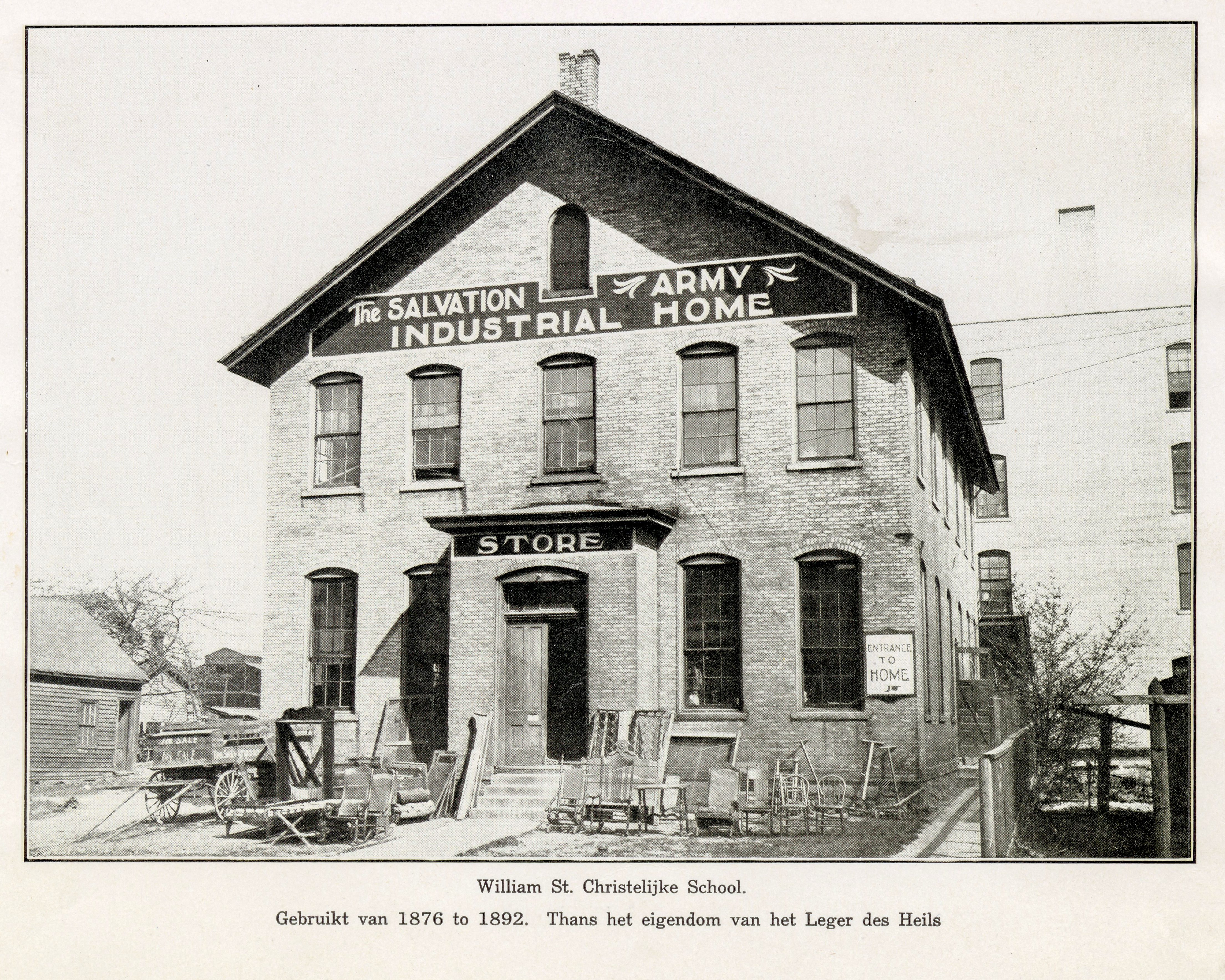
The first campus of the Theological School was the second floor of a Christian school building on 43 Williams Street, between South Ionia and South Spring, in downtown Grand Rapids. During this era, 1876-1892, the Theological School curriculum included a “literary” program (general education) and a “theological” program (seminary). Nearby was Spring Street Christian Reformed Church. This campus became a Salvation Army Industrial Home and Store in the 1890s. Today the property belongs to Mel Trotter Ministries.


Madison
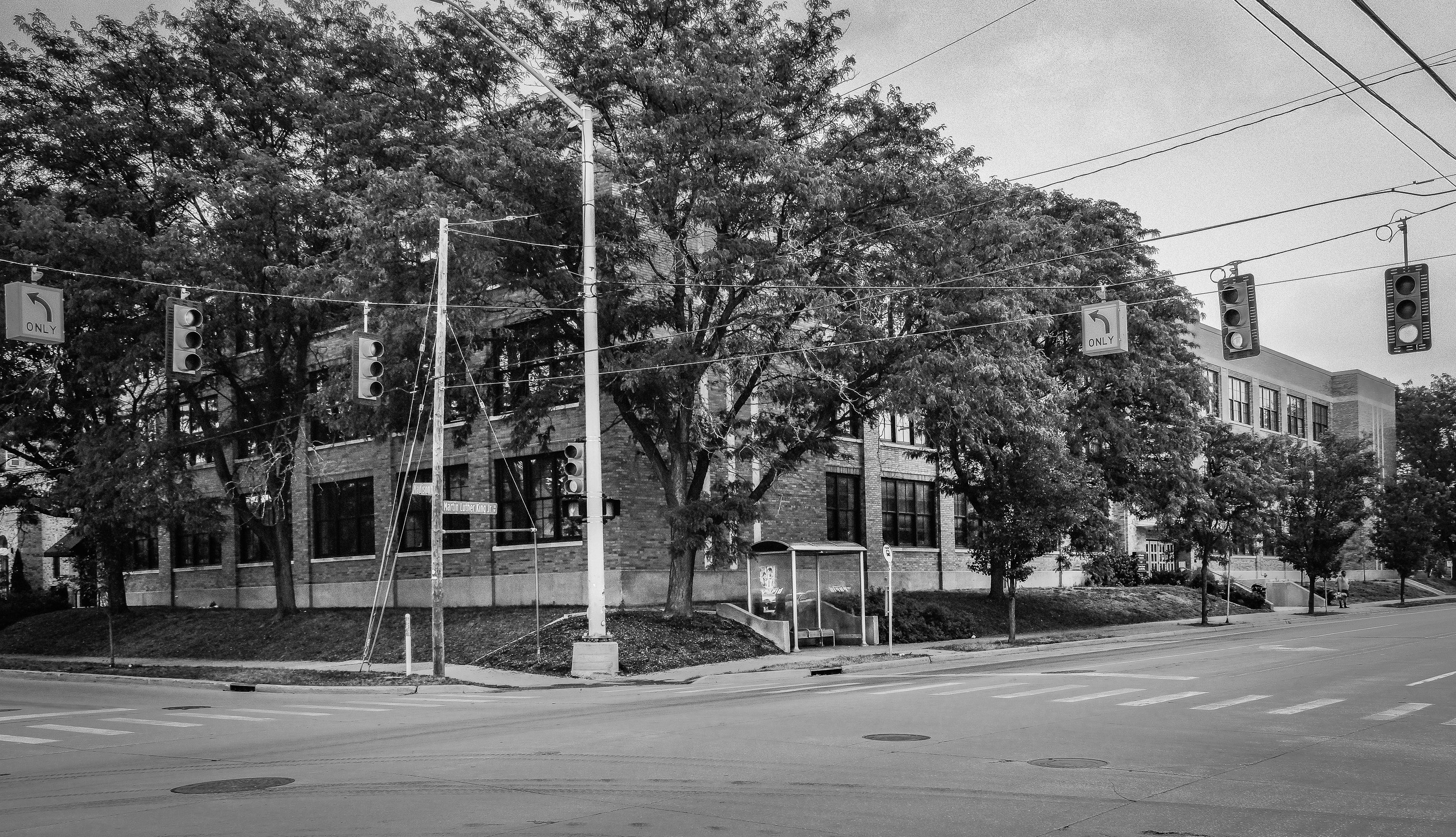
The second campus—of the Theological School and Calvin College—was located at the corner of then Madison Avenue and Fifth Avenue (later Franklin Street and now Martin Luther King Jr Street.) During the Madison years, 1892-1917, Calvin College emerged. In 1900 the pre-seminary-focused Literary Department became the Preparatory Department, a high school academy with “scientific” and “classical” tracks as well as the longstanding pre-seminary track. John Calvin Junior College started during the 1906-1907 school year, becoming Calvin College in 1908.
When the College became a four-year baccalaureate school in 1920, it ended the Preparatory Department, helped organize Grand Rapids Christian High School, and sold the Madison property to it. In 1972 the high school sold the building to Kent Country Social Services. Today the property is a Madison Christian Reformed Church campus that also houses the Inner-City Christian Federation and YMCA of Grand Rapids programs.


Franklin
Calvin chose the land that become the Franklin campus in 1909—Franklin Street between Benjamin and Giddings. The student population had grown rapidly after adding the Preparatory Department and Calvin College. It then began to raise money to build the new campus, completing the first building and moving to the new campus in 1917. In 1930-1931 the two schools became known as Calvin College and Seminary. Calvin added a seminary building, library, classroom building, and dorm before World War II to a campus designed for 500 students.
The student population jumped to over 1200 in 1946, as veterans returned home after the war and began to take advantage of G.I. Bill funding. The student population kept growing, as states and the federal government began pouring money into higher education to make it available to the “masses.” Calvin first added buildings and renovated the library; in the mid-1950s, it decided that continuing to expand the Franklin campus would be too expensive and complicated. It began looking for other options.


Knollcrest
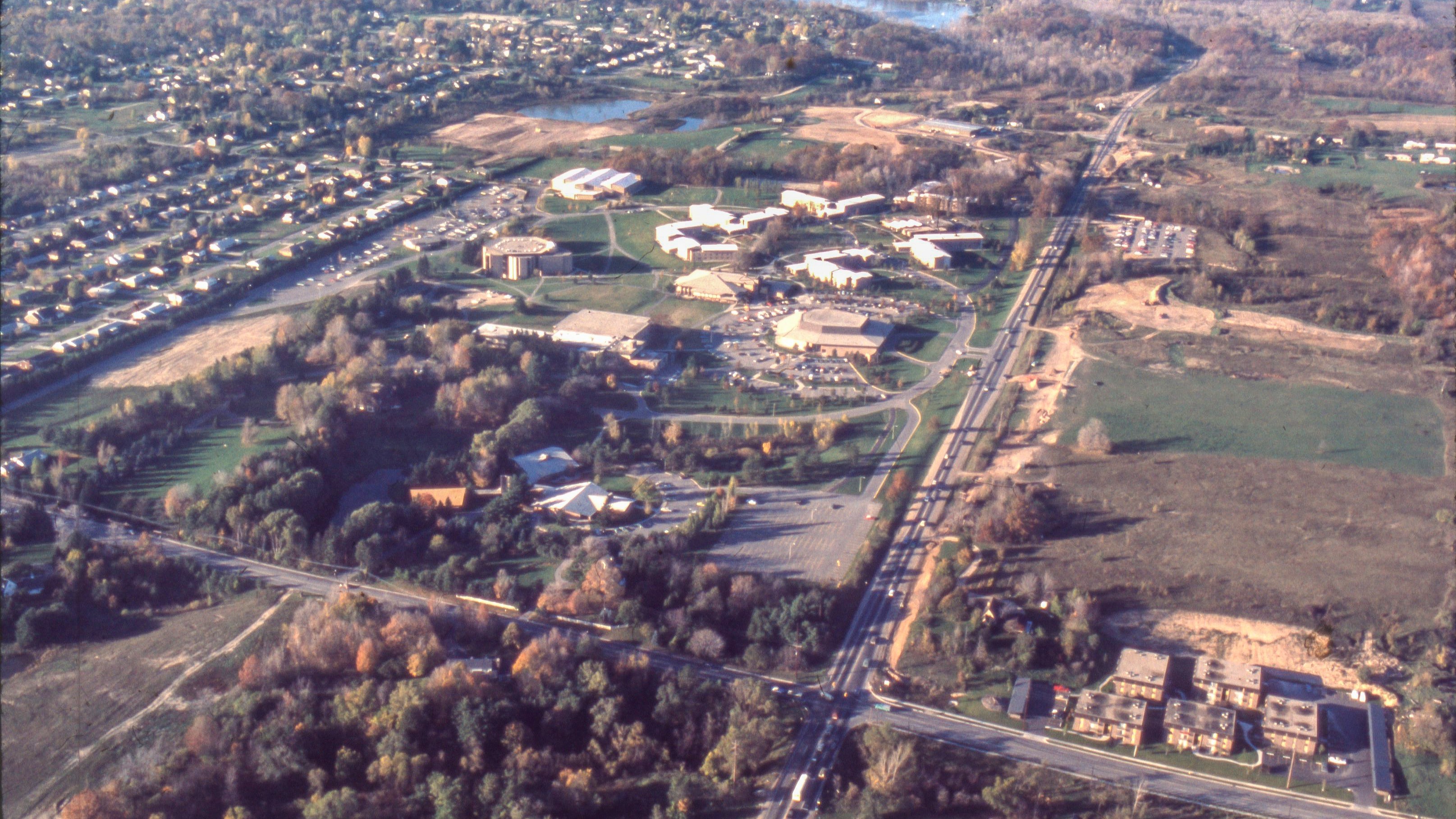
In the mid-1950s the College and Seminary looked at several options for a new campus in Southeast Grand Rapids where the suburbs met the countryside. In 1956 Calvin settled on the Knollcrest farm, at the corner of Burton Street and the East Beltline, completing the purchase in 1957. The first version of the Seminary building was completed in 1960 and the first phase of developing the College in 1962. Calvin added additional land on the east side of the East Beltline in the 1960s and purchased an apartment complex on the east side of campus in 1975. It added 157 acres, bordering on East Paris Avenue, in 1986.


The campus in 1972, looking northeast. By this point, only a few administrative offices remained on Franklin Street. On the center left, you can see excavation beginning for the Spoelhof College Center administration building. By 1975, Calvin would purchase the small Holiday Gardens apartment complex at the corner of Burton and the East Beltline (you can see part of it on the lower right) and would begin adding more apartment buildings.

The Calvin campus in 1978, looking from the Burton Street north-northwest towards Reeds Lake. You can see the College Center building (middle left) and the Knollcrest East apartments (lower right). The Science Building, Hekman Library, Hiemenga Hall, Fine Arts Center, Fieldhouse complex, and Commons were smaller than the current facilities. Calvin would add facilities over the next four decades, especially on the east side of campus, including the Nature Preserve and a bridge over the East Beltline. The 157 acres it would purchase in 1986 are to the left beyond the photo.
Calvin Theological Seminary and Calvin University today are no longer tied to a single campus. They share the Handlon campus just outside Ionia, at the Handlon correctional facility, where they partner with the Michigan Department of Corrections to deliver the Calvin Prison Initiative program. Both schools have an online presence and deliver courses and programs in various “distance learning” formats. And the University has off-campus programs in different parts of the world where it delivers semester-long “study abroad” programs.
***
William Katerberg is a professor of history and curator of Heritage Hall at Calvin University.
The cover photo is Calvin College and Seminary in 1975. You can see excavation for a parking lot on the far west side of campus and excavation on the Knollcrest East side where the College soon would begin building an apartment complex. Images courtesy of Heritage Hall and William Katerberg. For more on the Madison campus, check out The Madison Campus, Then and Now – Origins Online
Thank you very much for this history.