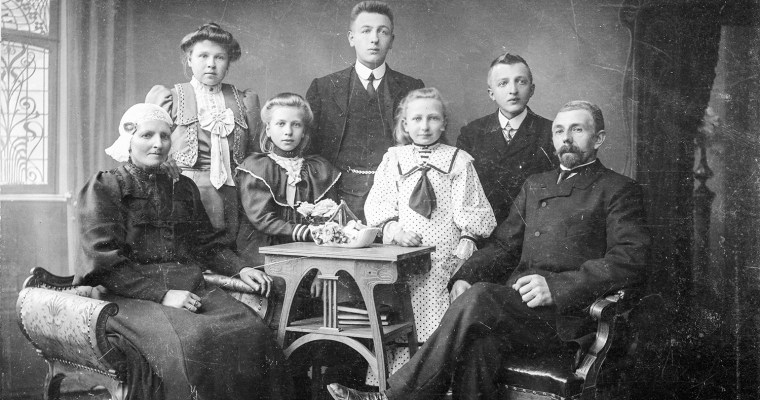
The Spring 2025 issue of Origins is in print and in the hands of subscribers. Here is a free article from the Spring issue. In it, Robert Schoone-Jongen tells the story of the Wispelwey family. It migrated from the Netherlands to the United States in 1910, arriving in …
In 1917 there was a major debate ongoing among Christian Reformed folk around Prospect Park, NJ. They needed to decide if it was time to establish a Christian high school. Most people in the mainly blue-collar, immigrant community saw education beyond the basics of reading …
The Spring 2023 issue (Volume 41, Issue 1) of Origins: Historical Magazine of the Heritage Hall Archives has been mailed to subscribers. If your not yet a subscriber you can order a copy by emailing Heritage Hall (crcarchives@calvin.edu) or subscribe online. This blog post includes a free article from the issue. (See the link below.)
Albertus Van Raalte is the focus of this issue. He was the Dutch Reformed immigrant dominee (Dutch for “reverend” or pastor) who led the first colony of Dutch immigrants to the United States in the 1846-47. In the next two decades he and they founded the town of Holland and surrounding villages, Hope College, and many Reformed Church in America and Christian Reformed Church congregations.
The issue is a celebration of decades of archival and scholarly work on Van Raalte. It was inspired by a joint project of the Heritage Hall Archives at Calvin University, the Van Raalte Institute (VRI) at Hope College, and the Dutch Consulate in New York City. The project involved Heritage Hall and the VRI digitizing their archival collections of Van Raalte material and putting them online. The Dutch Consulate helped fund the project. Our thanks to the consulate and government of the Netherlands for funding the project. You can find the digitized material here: Calvin – A. C. Van Raalte; Calvin – Dir Van Raalte; Hope – A. C. Van Raalte. The issue also was inspired by a new biography of the dominee by Robert Swierenga, who received a lot of research support from his colleagues at the VRI.
The issue includes an essay by Robert Swierenga that summarizes the Van Raalte’s life and work. He depicts the man not just as a pastor in the Netherlands and America, but a social entrepreneur–as an immigrant leader, town builder, college founder, politician, and businessman. Swierenga’s new biography–A. C. Van Raalte: Pastor by Vocation, Entrepreneur by Necessity–will be published by the Van Raalte press later this year.
Other Van Raalte material in the Spring issue includes a review of Swierenga’s book and a selection of letters written by the dominee to his son Dirk in 1874. In the letters, written during a trip the elderly Van Raalte took to the Kansas frontier, A. C. describes new Dutch settlements and fledgling churches and gives advice to Dirk about what to seek in life. In many ways the letters reveal a man reflecting on his life as a pastor and entrepreneur. A related article, by Douglas Firth Anderson, is about Henry Hospers. As a young man Hospers who was part of a colony led by another dominee in 1847: Henry Scholte. This colony settled in Iowa and founded the town of Pella. A generation later, a mature Hospers played the leading role in planting a new Dutch American colony in Sioux County Iowa and founding Orange City.
Finally, the issue includes two standalone articles. One is on the origins of the Calvin College-Hope College basketball rivalry in the 1920s, focusing on the Calvin side of the story. It’s by Chad Carlson, who teaches at Hope. Finally, Robert Schoone-Jongen tells the story of a group of Dutch immigrants to the United States whose ship in 1871 was hit on the leg of the trip between the Netherlands and England. They and the ship survived the accident, but all their baggage was lost at sea.
On 21 March 1956, my grandparents, Arie and Martha Verhagen boarded KLM flight 603 with their two small children from Amsterdam to New York City. A week earlier they had received visas under the Refugee Relief Act of 1953, allowing their immigration to the United …
See previous blog post for part I of this story. As assistant to the secretary of the Calvinist Resettlement Service, Agnes Flonk handled a good deal of the correspondence between potential sponsors and the necessary bureaucratic organizations. Many of the applicants she worked with were …
On August 27, 1955, Pieter Duinkerken showed up at the offices of the Calvinist Resettlement Committee to speak with Miss Agnes Flonk, the assistant secretary. The committee was created by the Christian Reformed Church (CRC), whose headquarters were in Grand Rapids, Michigan. Mr. Duinkerken himself was a recent immigrant from the Netherlands. He asked if perhaps his good friends, Johan Vos and Hendrikja Kluvers, fiancés planning to marry, might be able to immigrate to Grand Rapids to reunite with him.
Letter from Agnes Flonk to M. Reinsma
Flonk was not thrilled about this request. She had been working for months at that point to get Johan a position as a printer in Seattle, and she had finally submitted the paperwork to the State Department and the American Consulate in Rotterdam. She told Mr. Duinkerken that the matter was out of her hands. She would have to write to William De Rooy in Seattle to ask him to relinquish Vos as a potential employee. It had been difficult to find a Dutch immigrant with printing experience in the first place, so Flonk told Mr. Duinkerken that Mr. De Rooy had priority.
Luckily, Mr. De Rooy had no desire to stand in the way of friends reuniting, and so, despite the late stage of paperwork, efforts were made to change the future Mr. and Mrs. Vos’ destinations from Seattle, Washington to Grand Rapids, Michigan. I say luckily, because had Mr. De Rooy not been so generous, I might not be here today. Johan and Hendrikja Vos were my Oma and Opa.
Much of their story has been passed down through my family, but I learned more about the bureaucratic tribulations they went through to immigrate to the United States by looking through the collection of papers from the Resettlement Service Committee located in Heritage Hall. Seeing their story told through a series of forms and correspondence gives more insight into the role of the CRC in my family’s history. It also underscores the importance of community in helping immigrants and refugees find footing in a new country.
Hendrikja and Johan were born in 1930 and 1932, respectively, in the eastern province of Overijssel in the Netherlands. They were still young children when the Second World War broke out, but they saw their fair share of horror during the Nazi occupation from 1940-1945. Johan and his family were living in Arnhem by that time and lost their home to Operation Market Garden.
Meanwhile, to conserve food rations Hendrikja was sent to
live with an aunt and uncle on their farm near the German border. While there,
she and the family risked their lives to hide Jewish neighbors escaping the Holocaust.
Hendrikja (left) and aunt with whom she lived during the war, ca. 1944Hendrikja posing with her brother, Geert (left) and Johan wearing his KCT uniform (right) ca. 1954
After the war, Johan enlisted in the Korps Commandotroepen (KCT; Dutch special forces), serving from about 1954-5. During this time, his unit was sent to help with the aftermath of the flood of 1953. While there, he developed jaundice from contaminated water.
The couple met and began dating some time in the early 50s while Johan was in the KCT. By 1955 they were engaged and living in Hendrikja’s hometown, Hengelo. While planning their new life together, they ran into an issue that many of their Dutch countrymen were facing: a housing crisis.
click on images to enlarge
Nijmegen, 19521954Hengelo, 195419551955
In 1950, the Netherlands was one of the most densely populated countries in Europe. There were 800 people per square mile, and the population was growing rapidly. The birth rate was the highest in Europe: 22.5 per 1,000 in 1952, compared to nearby Belgium’s 16.7 per 1,000. The babies that were born in the Netherlands had a higher rate of survival—nearly double Belgium’s. Furthermore, by 1952 the Netherlands had one of the lowest mortality rates ever recorded: 7.3 per 1,000 in 1952 compared to 11.9 in Belgium and 9.6 in the United States.
For centuries, the Dutch made up for the small size of their
nation by reclaiming land from the sea and by colonizing other territories. Indonesia
was an extremely valuable and strategic part of what was called the Dutch East
Indies. After the Netherlands surrendered to the Nazi army in 1940, the Axis
powers, Germany, Hungary, Italy, and Japan divided colonial holdings into
spheres of influence. Indonesia was given to Japan’s sphere. After the war, the
Netherlands expected to retake control of the colony, but the people of Indonesia
saw this as their chance to take independence. Indonesia declared independence
in 1945. After four years of armed and diplomatic conflict, the Netherlands recognized
Indonesia as an independent country in 1949. As a result, many Dutch citizens
who had been living in the former colony returned to their homeland. This further
exacerbated the housing crisis.
Page from 1955 Acts of Synod
The Dutch government did its part to alleviate the housing scarcity by providing financial and bureaucratic assistance to those willing to emigrate elsewhere. In the early 50’s that mostly meant Canada. But in 1953, the United States passed a Refugee Act that expanded the definition of refugee to “include those who have been uprooted by World War II, those whose homes were destroyed by the great floods of 1953, and those who have been obliged to leave the Republic of Indonesia.” Thanks to the bombing of Arnhem during Operation Market Garden, Johan Vos was now eligible for immigration to the United States.
The Refugee Act of 1953 allowed for an additional 15,000 immigrants from the Netherlands to the United States on top of the previous quota of around 3,000. To handle the sudden influx of immigrants from the motherland, the heavily Dutch Christian Reformed Church of North America formed its resettlement service. It was one of 26 similar agencies recognized by the Department of State that were trusted to organize sponsors and jobs and provide general assurances that potential immigrant refugees would have a place to go and a way to contribute in America. Agnes Flonk of Grand Rapids, served as the assistant to the secretary of the Resettlement Committee. She worked tirelessly to match refugees with sponsors but was not immune to the frustration of having her carefully crafted plans upended at the last minute. Thankfully, Flonk sympathized with a group of friends asking to be reunited and gave the Voses’ case another go.
You never know where a story is going to take you. One that I read as a child led me to a digitization project in the Heritage Hall Archives at Calvin University. Now I am working on the collections associated with Albertus C. Van Raalte, …
Last week, Calvin University got word that alumnus and long time librarian Conrad Bult had passed away. Conrad was a periodicals and reference librarian and a historian, and he was much loved in Hekman Library, Heritage Hall, and the history department. This morning I was …
The Dutch know muck. And they know how to grow vegetables and flowers in it. At least that was my experience growing up.
“Muck farms” refers to agriculture in areas where wetlands were drained and the “muck” turned into productive “garden farms,” typically producing vegetables (but also flowers).
As a kid, I occasionally worked for Dutch immigrant vegetable farmers in the Niagara Peninsula in the late 1970s. I remember my cousins and I “topping” Brussel sprouts for a week one summer. In my teens and early twenties I worked in greenhouses (four summers) and a tree nursery (five summers). I remember preparing beds, using a rototiller to get the right mix of peat moss and fertilizer into the soil, and then transplanting chrysanthemum cuttings into them. A lot of families in these kinds of businesses went to Christian Reformed churches that my father pastored and sent their kids to associated Christian schools.
My father also told stories about this kind of work. In the 1950s, he migrated with his family from a village Drenthe, in the Netherlands, to Ontario, Canada. They spent the first couple of years in Holland Marsh, north of Toronto, working on muck farms that grew vegetables. He told stories about floods overcoming the dykes, washing over the farmland, and the occasional immigrant house floating away in the rising water.
Children in Holland Marsh, in a backyard next to a field, 1962. Dutch immigrants first came to Holland Marsh in the 1930s. They soon started a Christian Reformed Church congregation, one of the few in Ontario to predate World War II. The name of the town comes not from the immigrants, but Samuel Holland, a major in the British Army who first surveyed the region in the 1790s.
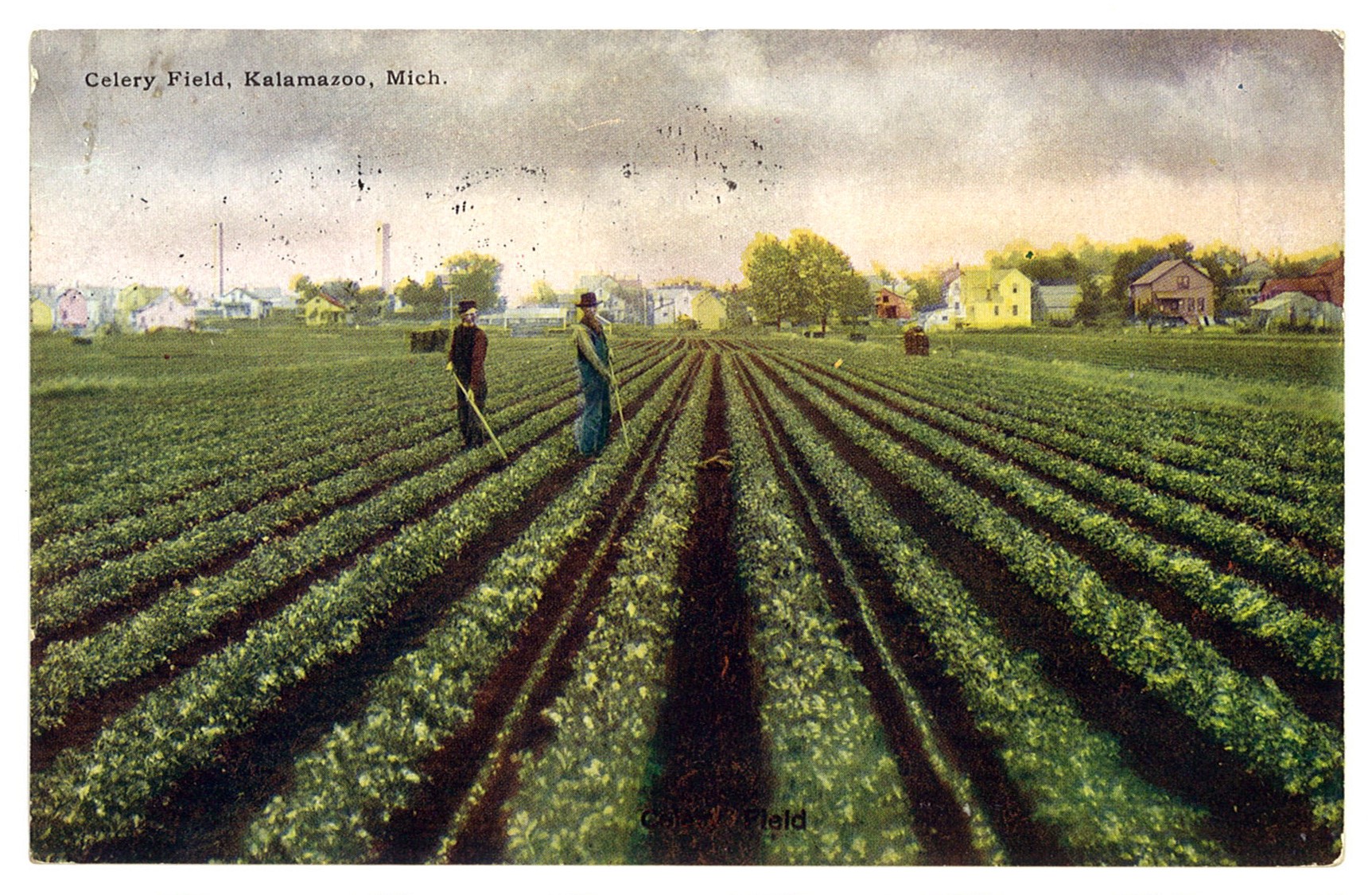
My experience was a common one among Dutch immigrants to the U.S. and Canada from the 1850s to the late-twentieth century. Immigrants grew celery in Michigan in Kalamazoo, Holland, Grand Haven, Muskegon, Montague-Whitehall, Hudsonville, Zeeland, Wyoming, Imlay city, even Newberry in the Upper Peninsula, and many more towns. In De Motte, Indiana. Celeryville, Ohio. Hollandale, Minnesota. The Wilhemina colony in Dunklin County, Missouri. And all the way West in Vorden Polder, California. And yes, in Holland Marsh, in Canada.
Work started by hand. At the turn of the century, mechanical celery planters and other new machinery allowed for bigger operations. The products sold locally and regionally, with Michigan farmers shipping their celery across the lake to Chicago and Milwaukee. Farmers with small, family operations organized cooperatives to market, sell, and ship their products and to better compete with larger family and corporate farms.
Celery was not only a food item in the late 1800s, but used to make medical nostrums. Advocates claimed it helped address rheumatism, neuralgia, insomnia and kidney troubles. It would help build “nervous strength” and aid digestion. In addition to celery seed ingredients included red cinchona, orange peel, coriander seed, lemon peel, water and alcohol. Some formulations may have included cocaine.
Over time, as is usually the case in capitalist economies, bigger operations gradually squeezed out smaller ones. As markets became national and even international, corporate farms in California put celery farmers in Michigan out of business or forced them to change their product. It’s worth noting that today immigrants remain crucial sources of labor in California agriculture, families and individuals from Mexico and Central America, wage laborers, not owners, and a mix of legal and undocumented.
The story is not just about celery, of course. Dutch farmers did indeed pioneer in marketing celery as a tasty, low calorie choice to munch or add to soups and other dishes. But they also grew onions, notably “onion sets”—dry, partly grown onion bulbs, raised from seeds the previous year. Farmers in South Holland, Illinois, were well-known for this crop. Onion sets are transplanted and grow into onions. They can be transplanted in early spring because they are not hurt by frost. Beyond celery and onions, Dutch “garden farmers” grew a wide variety of vegetables, lettuce, and the like.
Vegetable farmers who struggled to compete with California in the mid-twentieth century sometimes turned from celery and onions to growing flowers instead. At the turn of the twenty-first century in Ontario, some family-sized greenhouse operations like the one I worked in found that they could not compete with flowers grown in other parts of the world. They sometimes switched to vegetables and tomatoes.
This kind of story is not unique to Dutch immigrants, of course. “Garden farming” also attracted immigrants from Germany, Luxembourg, and other parts of Europe. Japanese immigrants on the West Coast had successful farms. Yet, it’s worth asking, what was it about Dutch immigrants that they were so successful in farming vegetables and flowers on farms that once had been wetlands?
The Netherlands is famous for much of it being below sea level and for reclaiming land from marshes and the sea. Local and regional governments in the U.S. and Canada sometimes recruited Dutch immigrants to drain marshes. Or, after having drained the marshes themselves, they recruited Dutch immigrants to farm the rich black soil. The Dutch also were famous for tulips, bulb flowers; so, perhaps onion were an obvious choice.
An onion farm in Newland, Indiana, southeast of Chicago.
Most operations, early on, in the nineteenth and early twentieth centuries, relied on hard work and family. Dutch immigrants took pride in both their thrift and work ethic. Having lots of “free” labor by children in large farm families helped too. Perhaps the rigorous Calvinist faith, as Max Weber thought, reinforced a Dutch ethnic component of thrift and willingness to work.
Finally, the tight-knit communities created by the Dutch, typically centered on their churches, helps explain the success of farmers in forming cooperatives to float loans and market and ship their produce. Very clannish, they knew each other well enough to trust one another as business partners. (I wonder whether divisions between Reformed sects affected some cooperatives; perhaps, in this case, practical need overcame theological disagreements.)
Today, we are aware of the ecological costs of draining wetlands. Turning marshes into farms changes ecosystems and displaces native birds, animals, insects, and plants. Intensive agriculture uses up the rich black soil created from the marshlands. In drought times, before crops come in or after harvesting, dust storms can be a problem. Contemporary environmental laws and regulations make it unlikely that wetlands will be drained to become muck farms in the future.
In the late twentieth century and early twenty-first, some Midwestern Dutch American farmers who found they could not compete with big growers in California sold or leased their lands to nature conservancies. Where farmland gradually returned to wetland, the birds often have returned too.
William
Katerberg is professor of history and interim curator of Heritage Hall at
Calvin University.
***************
There are a variety of stories in Origins: Historical Magazine of the Archives on farming operations like these: Kalamazoo (1998) and Coopersville (2002) in Michigan; Holland Marsh (2006) in Ontario, Canada; and Roseland (1996) in Illinois. On Celeryville, Ohio, check out this short history. Dutch Muck—and Much More: Dutch Americans in Farming, Religion, Art, and Astronomy (Holland, MI: Van Raalte Press, 2019), includes an essay by Robert Swierenga, who tells the story of celery farming across North America, and one Ken Bult that looks at “onion sets” in South Holland, Illinois.
My title — “Play ball?” — really should have two question marks. I picked this topic because I’ve been watching to see whether North Americans will get major league baseball this Covid-19 summer. That’s one question. The other is whether Christian athletes should play on …